HOLIDAY WORD PLAY—“I’m Stuffed!”

covet vocab word cool word clubEditor’s note: This month, the Cool Word Club will focus on the holidays with some oh-so-festive words!

So you had a little too much to eat at your Christmas dinner? You’re not alone.

Holiday meals are a common time for people to overeat. But don’t panic.

Just remember: To gain one pound of body fat, you need to eat an extra 3,500 calories. That’s a lot of food! A slice of pumpkin pie has about 200 to 300 calories. A half cup of mashed potatoes has approximately 150 calories.

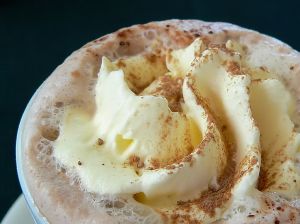
And a cup of hot chocolate? Well, if it’s a sugar-free version, it’s got about 50 calories. But if it’s made with milk and has some whipped cream on top, it’s likely to have around 200 calories.

So if you start to covet (see definition below) that steamy cup of hot chocolate that your friend is sipping, you might want to ask yourself whether you really want the whipped cream after all!

Speak your mind: What do you think is the best way to avoid overeating?

COVET: To desire enviously.

HOLIDAY WORD PLAY—What a Big Job!

alacrity vocab word cool word clubEditor’s note: This month, the Cool Word Club will focus on the holidays with some oh-so-festive words!

For more than 100 years, the US Post Office has answered children’s letters that are addressed to Santa. In 1912, the Postal Service officially launched the much beloved program known as Letters to Santa. It grew so large that the public, charitable organizations and community groups were enlisted to also help respond to the young letter writers.

As the program expanded, many Post Offices allowed schools, charities and private citizens to “adopt” individual letters and fulfill the child’s request for gifts. The largest such program is located in New York City, where more than a half million letters to Santa are received from children each year.

Of course, all this happens before Christmas eve. That’s when Santa proceeds with alacrity (see definition) in order to complete the enormous task of delivering all his Christmas presents. Talk about a big job!

If you’d like to keep track of Santa’s travels on Christmas eve, check www.noradsanta.org.

Speak your mind: Do you have any tasks that you complete with alacrity?

ALACRITY: With readiness, willingness and promptness.

HOLIDAY WORD PLAY—With a Bow on Top!

Christmas-Picture-Cool Holiday wordsEditor’s note: This month, the Cool Word Club will focus on the holidays with some oh-so-festive words!
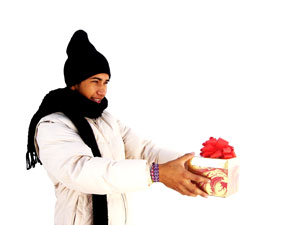
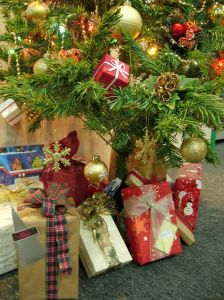
For many people, gift giving is one of the joys of celebrating Christmas. Another pleasure is wrapping all those presents!

Some gift wrappers work hard to make sure that the paper is lined up perfectly at the edges, and the bow that goes on top must match nicely. Other people aren’t nearly as careful in their wrapping technique. The paper isn’t folded crisply at the corners, and the tape may be slapped on haphazardly.

Regardless of your approach to gift wrapping, chances are you have an opinion on the commercialization of Christmas. Many people believe that there’s too much emphasis on holiday shopping.

Another common complaint is the early display of Christmas decorations. In some areas, colored lights are hung right after Halloween!

Other people cringe when they hear Christmas music early in the season. For them, the sound of “Fa la la la la” or “Ho! Ho! Ho!” is just a hackneyed (see definition below) expression of the holiday spirit.

Speak your mind: Do you think that Christmas has become too commercialized? If so, what’s the solution?

HACKNEYED: Clichéd, trite, overused.

HOLIDAY WORD PLAY: Hello, Rudolph!

Rudolph Cool Holiday WordEditor’s note: This month, the Cool Word Club will focus on the holidays with some oh-so-festive words!
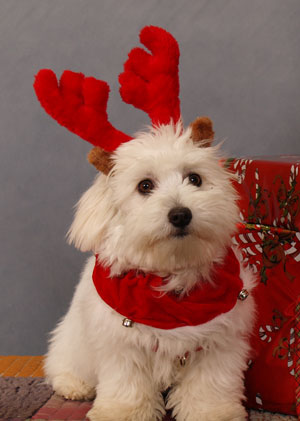
Rudolph is one of the most iconic figures in Christmas lore. We all have vivid images of that red-nosed reindeer leading Santa’s sleigh.

Eight of Santa’s reindeer appeared in the classic Christmas poem ‘‘A Visit From St. Nicholas.” More commonly known as “’Twas the Night Before Christmas,” it was first published in 1823. You can read the poem here: www.poetryfoundation.org/poem/171924

Rudolph was not added to Santa’s famous reindeer team until later. Now, the song and television show named after him are so much a part of American culture that some people forget that reindeer are real animals. But they are!

Reindeer, believed to be the same species (Rangifer tarandus) as caribou, are fascinating animals. Though caribou typically walk slowly, they can run at speeds that exceed 45 mph. Interestingly, caribou are also wayfaring (see definition below) animals, traveling up to 3,000 miles a year.

To read more about reindeer and caribou, go to the National Museum of Natural History’s link: http://www.mnh.si.edu/arctic/html/caribou_reindeer.html

Speak your mind: Can you think of any other wayfaring animals?

WAYFARING: Traveling, especially on foot.

HOLIDAY WORD PLAY—Light Up the Sky!

Luminous | Vocabulary from the Cool Word Club

Editor’s note: This month, the Cool Word Club will focus on the holidays with some oh-so-festive words!

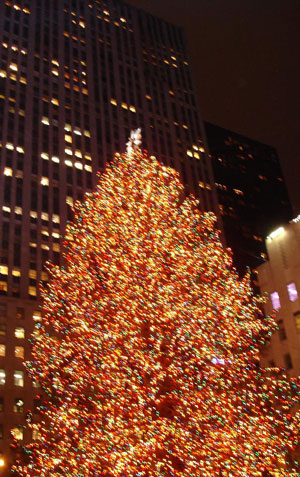
In New York City, the holidays are ushered in with the annual lighting of the Christmas tree at the iconic Rockefeller Center.

The first tree-lighting ceremony took place there in 1933. It was televised for the first time in 1955 on “The Howdy Doody Show.” Now, millions of people around the world watch this celebration each year on television. Meanwhile, huge crowds gather in the area around the tree to witness the lighting ceremony firsthand.

The 2012 tree, which came from New Jersey, is an 80-foot Norway spruce that is estimated to weigh 10 tons. In fact, the tree is so large that a crane had to be used to hoist it into place.

Not surprisingly, it was no easy feat to cover such an enormous tree with lights. When the decorating was complete, a total of 30,000 lights graced the tree’s branches to create a luminous (see definition below) spectacle against the dark evening skies of Manhattan.

It is indeed a sight to behold!


Speak your mind: What annual traditions do you consider to be the most important to the holiday season—and why?

LUMINOUS: Radiating light, bright or shining.


HOLIDAY WORD PLAY—A Festival of Lights

Betoken | Vocabulary from the Cool Word Club

Editor’s note: This month, the Cool Word Club will focus on the holidays with some oh-so-festive words!

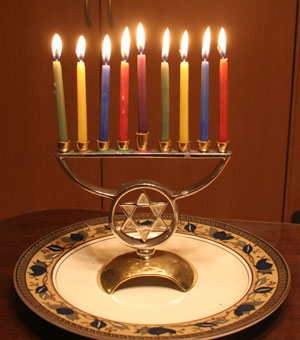
The menorah, which means candelabrum or lampstand, is one of the oldest symbols of the Jewish faith. When a family unpacks its menorah, it betokens (see definition below) the arrival of Hanukkah.

A candle is lit each night of the eight-day observance of Hanukkah, which commemorates the Jewish people’s victory over its ancient oppressors. A ninth candle is used to light the other candles.

During Hanukkah, it is not only customary for children to play games with dreidels, or spinning tops, but also to receive gifts of money. In addition, it is part of Jewish custom to give increased offerings to charity each day of the holiday. Special meals, singing and prayer services are included as part of Hanukkah as well.

Speak your mind: Can you think of any items that betoken the arrival of a particular holiday in your family?

BETOKEN: To be a sign of beforehand, give evidence of, indicate.

HOLIDAY WORD PLAY—A Gift for You…

Beneficent | Vocabulary from the Cool Word ClubEditor’s note: This month, the Cool Word Club will focus on the holidays with some oh-so-festive words!

Do you like to shop? Some people love it, and other people…well, they just hate it! But either way, Americans do a lot of shopping. In fact, the average US consumer spends about 182 hours shopping each year, according to one survey.

If you love shopping, you might focus on the new clothes, electronics or other items you usually bring home. Or perhaps you dream about finding your favorite items on sale.

If shopping is not your thing, you may dwell on the throngs of people in the stores or the way your feet hurt after walking around the mall all afternoon. For these reasons, you may prefer to do your shopping online.

How you feel about shopping may also relate to your thoughts on gift-giving. For example, do you agree with the adage ‘Tis better to give than to receive? If so, you may be a beneficent (see definition below) person who sees lots of opportunities to give to other people. For example, you may not be that interested in giving material gifts, but instead prefer to give of your time by volunteering at a neighborhood community center.

This just goes to show that gift-giving doesn’t always require a trip to the mall!


Speak your mind: What do you think is the real purpose of gift-giving?

BENEFICENT: Characterized by acts of kindness, charity or generosity.


HOLIDAY WORD PLAY—Woof, Woof!

Mollify | Vocabulary from the Cool Word Club

Editor’s note: This month, the Cool Word Club will focus on the holidays with some oh-so-festive words!
That jolly Santa in the mall makes passersby smile. So it’s not surprising that a lot of people think it’s fun to dress up their pets to look like Santa, a reindeer or even an elf.

Americans own about 78 million dogs and roughly 86 million cats. Plenty of these dog and cat owners start shopping for holiday costumes just as soon as they arrive on the store shelves.

But if the animals could talk, many of them might say that it’s not so fun to don these funny-looking clothes. In fact, lots of pets squirm, bark (or meow) or even run out of the room when their owners come at them with the costume in hand.

In these cases, pet owners may decide to give the animal a treat to mollify (see definition below) him/her. It could be a big, crunchy dog biscuit or just a pinch of catnip.

That might work for a minute or two. But sooner or later, Fido and Fluffy will want to shake off that costume and just go back to being a dog or a cat!


Speak your mind: Do you think it’s acceptable for pet owners to dress up their animals for the holidays?

MOLLIFY: To calm in temper, appease, pacify, soothe.


“Hair Today”…Gone Tomorrow?

Hirsute | Vocabulary from the Cool Word Club

Here’s a fun question: Do you know many hairs the average person has on his/her head?

The exact number varies from person to person, but a good estimate is about 100,000 to 150,000. That’s a lot of hair! Interestingly, a person’s hair color is believed to play a role in the number of hairs on his/her head. For example, blondes are estimated to have about 140,000 strands of hair, people with brown hair have an average of 108,000 strands and redheads have approximately 90,000 strands of hair on their heads.

Of course, all that hair just keeps on growing. For most people, the hair on their heads grows about a half inch a month. That’s good news for haircutters!

Some people, however, prefer to let their hair grow long. According to the Guinness World Records, the world’s longest documented hair belongs to Xie Qiuping of China, whose hair was measured at more than 18 feet long!

That, you could say, is one hirsute (see definition below) individual!


Speak your mind: What do you consider to be the most appropriate length for a person to grow his/her hair?

HIRSUTE: Hairy.


When Words Aren’t Enough…

Gesticulate | Vocabulary from the Cool Word Club

Sometimes you can communicate a great deal without even using words.

If you’re giving a speech to an audience, for example, or just having a casual conversation with a friend, you may want use your hands or another part of your body, such as your head, to drive home an important point.

Some of the most common gestures that Americans use in daily life include giving someone a “thumbs-up” or “thumbs-down” sign or a “high-five.” Nodding one’s head in agreement is another widely used form of nonverbal communication.

It’s important to remember, though, that certain gestures that are well known in the United States may have different meanings in other parts of the world. If an American gives another person a thumbs-up sign, for example, this will likely signify approval. In other areas of the world, such as Thailand and parts of the Middle East, this same gesture is sometimes used in a disrespectful manner or as a form of mockery.

So if you are inclined to gesticulate (see definition below) when communicating with someone from another country, just make sure that your gesture means the same thing to both of you!


Speak your mind: What gestures do you find to be the most effective when you are communicating an important message?

GESTICULATE: To use gestures for emphasis, especially when speaking.